

Subscribe to our ▶️ YouTube channel 🔴 for the latest videos, updates, and tips.
Subtraction of 3-digit numbers with regrouping are explained here with examples.
As you borrow from the tens column, you can borrow from the
hundreds column also.
REMEMBER:
1 ten = 10 ones
1 hundred = 10 tens
What is Regrouping in Subtraction?
Regrouping in subtraction is the process of taking 1 from a higher place value and adding it to the next lower place value when the digit being subtracted is larger than the digit above it.
Regrouping is also called borrowing.
Simple Definition:
Regrouping in subtraction means exchanging 1 ten for 10 ones, or 1 hundred for 10 tens, when the top digit is smaller than the bottom digit. This process is also called borrowing.
Steps for Subtracting 3-Digit Numbers with Regrouping:
To subtract 3-digit numbers with regrouping, follow these simple steps:
- Write the numbers in columns.
- Start subtracting from the ones place.
- Regroup (borrow) if the top digit is smaller.
- Move to the tens place and regroup if needed.
- Subtract the hundreds place.
- Write the final answer.
Solved Examples of 3-Digit Subtraction with Regrouping:
|
1. Subtract 674 – 458 Step I: Arrange the numbers vertically. Step II: Subtract the ones column. Since, 8 > 4 and we cannot subtract 8 from 4. So, we regroup 7 tens and 4 ones. Now, 7 tens + 4 ones = 6 tens and 14 ones. 14 – 8 = 6 ones Step III: Subtract the tens column. 6 – 5 = 1 tens Step IV: Subtract the hundreds column. 6 – 4 = 2 hundreds. |
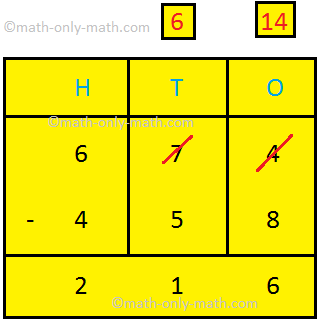 Thus, 674 – 458 = 216 |
2. Subtract 747 – 489.
|
Step I: Arrange the numbers vertically. Step II: Subtract the ones column. Since, 9 > 7 and we Step III: Subtract the tens column. Since, 1 ten is Step IV: Subtract the hundreds column. 6 – 4 = 2 hundreds. |
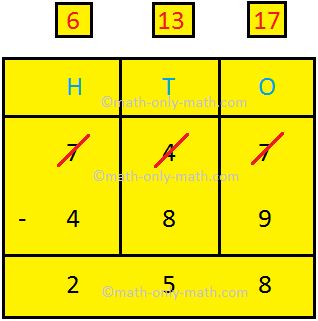 Thus, 747 – 489 = 258 |
3. Let us subtract 256 from 384.
Write the numbers one below the other as shown.
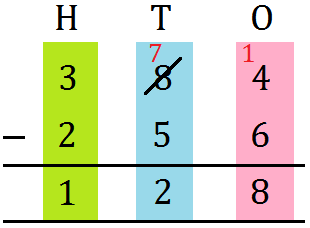
Step I: Subtract the ones.
But 6 ones cannot be taken away from 4 ones.
So, borrow 1 ten from 8 tens.
7 tens remain in place of 8 tens.
Cross out 8 and write 7.
Regroup: 1 ten (borrowed) with 4 ones = 14 ones
14 ones – 6 ones = 8 ones
Write 8 in the ones place.
Step II: Subtract the tens.
7 tens (remaining) – 5 tens = 2 tens
Write 2 in the tens place.
Step III: Subtract the hundreds.
3 hundreds 2 hundreds = 1 hundred
Write 1 in the hundreds place.
The difference is 128.
4. Let us subtract 173 from 649.
Write the numbers one below the other as shown.
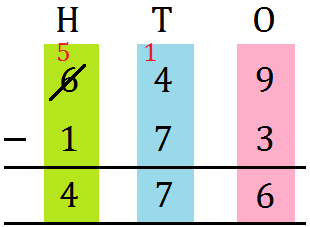
Step I: Subtract the ones.
9 ones – 3 ones = 6 ones
Write 6 in the ones place.
Step II: Subtract the tens.
But 7 tens cannot be taken away from 4 tens.
So, borrow 1 hundred from 6 hundreds.
5 hundreds remain in place of 6 hundreds.
Cross out 6 and write 5.
Regroup: 1 hundred (borrowed) with 4 tens = 14 tens
14 tens -7 tens = 7 tens
Write 7 in the tens place.
Step III: Subtract the hundreds.
5 hundreds (remaining) – 1 hundred = 4 hundreds
Write 4 in the hundreds place.
The difference is 476.
5. Let us subtract 245 from 732.
Here we need to regroup twice.
Write the numbers one below the other as shown.
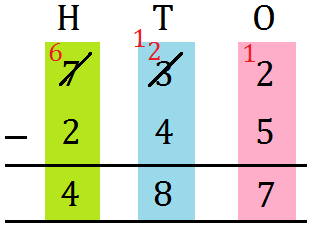
Step I: Subtract the ones.
But 5 ones cannot be taken away from 2 ones.
So, borrow 1 ten from 3 tens.
2 tens remain in place of 3 tens.
Cross out 3 and write 2.
Regroup: 1 ten (borrowed) with 2 ones = 12 ones
12 ones – 5 ones = 7 ones
Write 7 in the ones place.
Step II: Subtract the tens.
But 4 tens cannot be taken away from 2 tens (remaining).
So, borrow 1 hundred from 7 hundreds.
6 hundreds remain in place of 7 hundreds.
Cross out 7 and write 6.
Regroup: 1 hundred (borrowed) with 2 tens (remaining) = 12 tens
12 tens – 4 tens = 8 tens
Write 8 in the tens place.
Step III: Subtract the hundreds.
6 hundreds (remaining) – 2 hundreds = 4 hundreds
Write 4 in the hundreds place.
The difference is 487.
Word Problems on 3-Digit Subtraction with Regrouping:
6. There are 705 birds living in the garden. During winters,
438 flew away. How many birds were left in the garden?
Solution:
Birds in the garden = 705
Birds flew away during winters = 438
7. There are 600 flowers in Toby’s garden and 256 flowers in Ehsan’s garden. How many more flowers are there in Toby’s garden?
Solution:
We have to subtract 256 from 600.
Step I:
First borrow 1 hundred for tens column.
Now, we have 10 tens.
Again borrow 1 ten for ones column.
Now, we have 10 ones.
10 – 6 = 4 ones.
Write 4 in ones place.
Step II:
Now, subtract the tens.
9 – 5 = 4
Write 4 in tens place.
Step III:
Subtract the hundreds.
5 – 2 = 3
Write 3 in hundreds place.
Thus, there are 344 more flowers in Toby’s garden.
Note:
Always subtract from right to left (Ones → Tens → Hundreds). If a digit on top is smaller than the digit below it, regroup before subtracting.
Practice Questions:
1. Subtract and Find the Difference
(a) 432 − 158 = ______
(b) 615 − 287 = ______
(c) 704 − 256 = ______
(d) 821 − 394 = ______
(e) 563 − 178 = ______
(f) 900 − 475 = ______
(g) 742 − 386 = ______
(h) 680 − 295 = ______
(i) 531 − 267 = ______
(j) 854 − 476 = ______
Answer Key
1. (a) 274
(b) 328
(c) 448
(d) 427
(e) 385
(f) 425
(g) 356
(h) 385
(i) 264
(j) 378
Worksheet on Subtraction of 3-Digit Numbers with Regrouping:
I. Subtract the following:
(i) 625 – 56
(ii) 464 – 79
(iii) 552 – 88
(iv) 814 – 156
(v) 732 – 163
(vi) 406 – 387
(vii) 862 – 195
(viii) 608 – 125
(ix) 233 – 156
(x) 428 – 397
(xi) 786 – 397
(xii) 984 – 592
(xiii) 642 – 555
(xiv) 983 – 394
(xv) 437 – 157
(xvi) 840 – 800
Answers:
I. (i) 569
(ii) 385
(iii) 464
(iv) 658
(v) 569
(vi) 19
(vii) 667
(viii) 483
(ix) 77
(x) 31
(xi) 389
(xii) 372
(xiii) 87
(xiv) 589
(xv) 280
(xvi) 40
II. Subtract the numbers:
(i) 235 – 67
(ii) 652 – 285
(iii) 447 – 285
(iv) 672 – 87
(v) 805 – 299
(vi) 844 – 666
(vii) 554 – 368
(viii) 422 – 173
(ix) 892 – 509
Answers:
II. (i) 168
(ii) 367
(iii) 162
(iv) 585
(v) 506
(vi) 178
(vii) 186
(viii) 249
(ix) 383
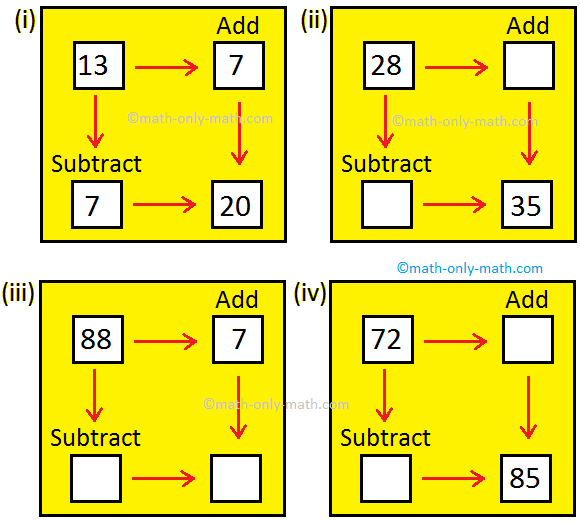
III. Fill in the missing number. First one has been done for
you.
Answers:
III. (ii) 7, 7
(iii) 7, 7
(iv) 13, 13
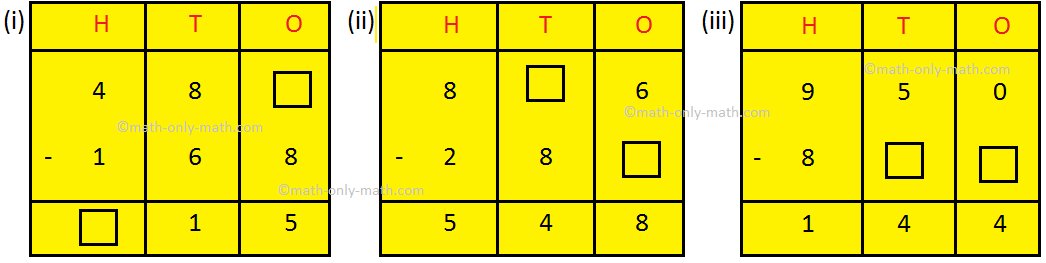
IV. Fill in the missing numbers:
Answers:
IV. (i) 3, 3
(ii) 4, 2
(iii) 0, 6
V. Subtract of 3-digit numbers by regrouping as shown.
|
(i) |
H T O 6 1 2 – 1 4 5 1 2 8 |
(ii) |
H T O 3 8 4 – 1 5 9
|
|
(iii) |
H T O 5 8 7 – 2 3 8
|
(iv) |
H T O 6 9 8 – 3 6 9
|
|
(v) |
H T O 8 8 2 – 3 7 5
|
(vi) |
H T O 5 8 4 – 1 5 7
|
Answers:
V. (ii) 225
(iii) 349
(iv) 329
(v) 507
(vi) 427
VI. Subtract of 3-digit numbers by regrouping as shown.
|
(i) |
H T O 3 1 – 1 8 1 2 9 1 |
(ii) |
H T O 2 2 6 – 1 4 4
|
|
(iii) |
H T O 7 6 8 – 4 7 4
|
(iv) |
H T O 5 3 7 – 3 9 6
|
|
(iii) |
H T O 7 6 8 – 4 7 4
|
(iv) |
H T O 5 3 7 – 3 9 6
|
|
(v) |
H T O 8 6 4 – 2 9 4
|
(vi) |
H T O 9 0 8 – 4 5 7
|
|
(vii) |
H T O 4 6 3 – 2 9 1
|
(viii) |
H T O 9 4 8 – 7 6 7
|
Answers:
VI. (ii) 82
(iii) 294
(iv) 141
(v) 570
(vi) 451
(vii) 172
(viii) 181
VII. Subtract of 3-digit numbers by regrouping twice as shown.
|
(i) |
H T O 1 7 0 1 – 4 3 9 3 7 9 |
(ii) |
H T O 6 3 3 – 3 6 6
|
|
(iii) |
H T O 7 4 2 – 3 9 9
|
(iv) |
H T O 3 8 4 – 1 8 5
|
|
(v) |
H T O 6 6 2 – 2 7 3
|
(vi) |
H T O 5 6 0 – 2 7 7
|
|
(vii) |
H T O 5 3 7 – 3 0 8
|
(viii) |
H T O 4 6 2 – 2 9 4
|
|
(ix) |
H T O 9 4 8 – 7 6 9
|
(x) |
H T O 8 1 5 – 4 3 6
|
Answers:
VII. (ii) 267
(iii) 343
(iv) 199
(v) 389
(vi) 283
(vii) 229
(viii) 168
(ix) 179
(x) 379
Answer:
We need to regroup when a digit in the top number is smaller than the digit directly below it. For example, in 432 − 158, we regroup because 2 is smaller than 8.
Answer:
Yes. The terms regrouping and borrowing mean the same thing in subtraction. Both involve taking a value from a higher place value and converting it into smaller units.
Answer:
To subtract 3-digit numbers with regrouping:
- Arrange the numbers in columns.
- Start subtracting from the ones place.
- Regroup whenever the top digit is smaller than the bottom digit.
- Continue with the tens and hundreds places.
- Write the final difference.
Answer:
Place value helps us understand that:
- 10 ones = 1 ten
- 10 tens = 1 hundred
- 10 hundreds = 1 thousand
These relationships make regrouping possible during subtraction.
Answer:
Yes. Sometimes regrouping is needed in both the ones and tens columns. For example, in 432 − 158, regrouping occurs twice before finding the answer.
Answer:
In subtraction without regrouping, every digit in the top number is greater than or equal to the digit below it. In subtraction with regrouping, at least one digit in the top number is smaller and requires borrowing.
Answer:
Subtraction with regrouping is used when:
- Calculating change while shopping.
- Finding the difference between two amounts.
- Tracking expenses and savings.
- Comparing distances, scores, or quantities.
Answer:
Most students begin learning 3-digit subtraction with regrouping in Grade 2 or Grade 3, depending on the curriculum followed by their school.
From Subtraction of 3-Digit Numbers with Regrouping to HOME PAGE
Didn’t find what you were looking for? Or want to know more information
about Math Only Math.
Use this Google Search to find what you need.