

Subscribe to our ▶️ YouTube channel 🔴 for the latest videos, updates, and tips.
What Does “Estimate to the Nearest Thousand” Mean?
Estimating to the nearest thousand means rounding a number to the closest multiple of 1000.
This helps make numbers simpler and is very useful in:
- Mental math
- Quick calculations
- Real-life situations like money, distance, and population.
Easy Rule for Estimating to Nearest Thousand:
To estimate or round off a number to the nearest thousand, follow these simple steps:
Step I: Look at the hundreds digit of the given number.
Step II: If the hundreds digit is 0, 1, 2, 3, or 4, round the number down to the previous thousand.
Step III: If the hundreds digit is 5, 6, 7, 8, or 9, round the number up to the next thousand.
Step IV: Change the hundreds digit, tens digit and ones digit to zero.
0 to 4 → Round Down ⬇ | 5 to 9 → Round Up ⬆
This is the basic rounding rule used for nearest thousand estimation.
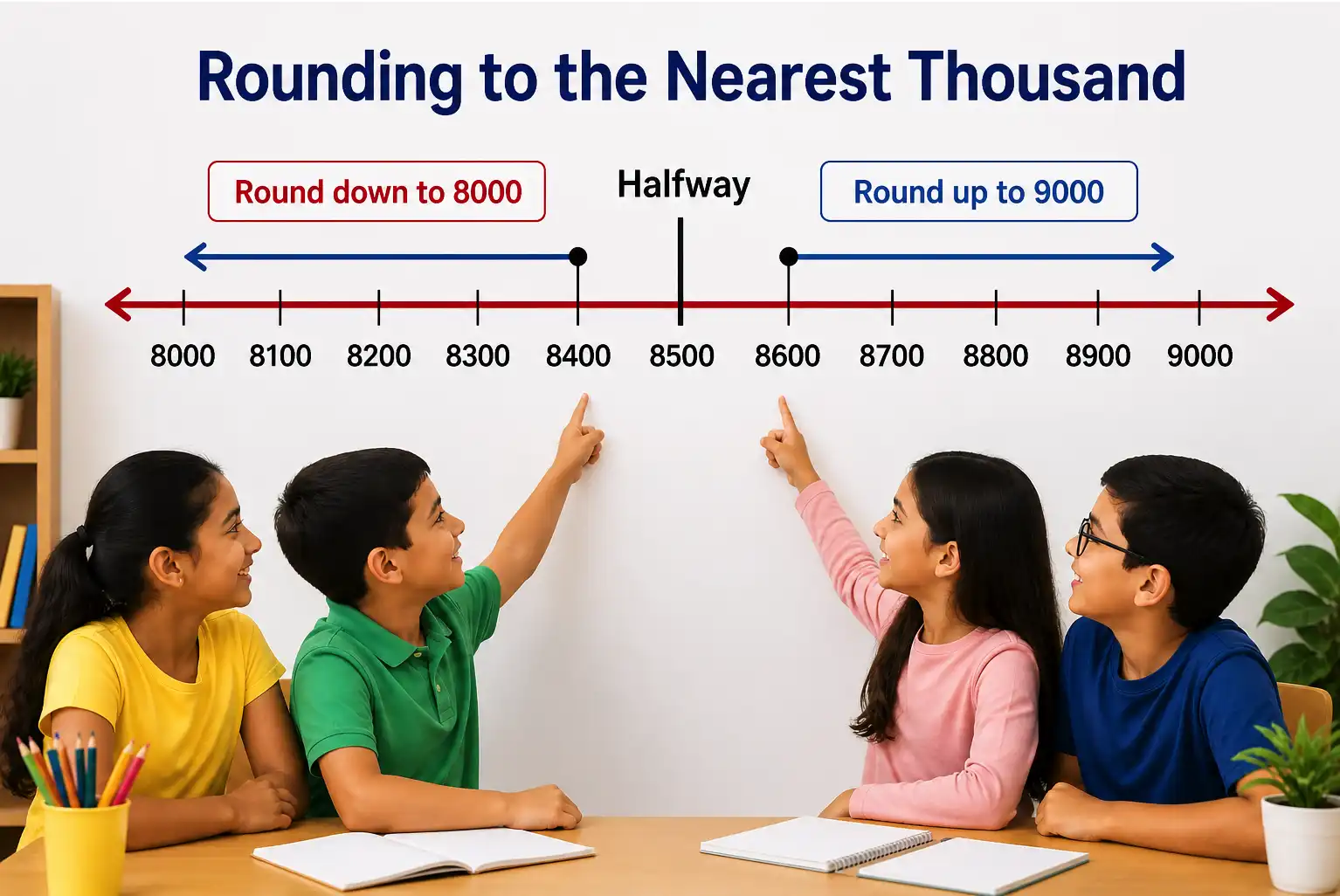
The number that are halfway or above are rounded off to the next 1000 and the numbers that are less than halfway are rounded off to the existing 1000.
For Example:
(i) 8400 is closer to 8000 (or less than halfway). So, it can be rounded down to 8000.
(ii) 8600 is closer to 9000 (or above the halfway). So, it can be rounded up to 9000.
(iii) 8500 is closer to 9000 (or at the halfway). So, it can be rounded up to 9000.
Estimate to Nearest Thousands GAME:
🎯 Estimate to Nearest Thousand
👧📘 👦✏️ 👩🎓📊 👨🎓📚
Loading…
Steps for Rounding to the Nearest Thousand:
In order to estimate to nearest thousands we follow the following procedure:
Step I: Obtain the number.
Step II: Examine the digit at hundreds place.
Step III: If the digit at hundreds place is less than 5, replace each one of the digits at hundreds, tens and ones or units place by 0 and keep all other digits as they are.
If the digit at hundreds place is 5 or greater than 5, increase the digit at thousands place by 1 and replace each one of the digits at hundreds, tens and ones place by 0.
The number so obtained is the number rounded off to the nearest thousands.
For example:
Round off each of the following numbers to nearest thousands.
(i) 14329
Solution:
The given number is 14329.
Its
digit at hundreds place is 3, which is less than 5. So, we replace each
of the hundreds, tens and ones digits by 0 and keep the other digits as
they are.
So, the number 14329 is rounded off to nearest thousands as 14000.
(ii) 14729
Solution:
The given number is 14729.
Its
digit at hundreds place is 7, which is greater than 5. So, we increase
the digit at thousands place by 1 and replace each one of the digits at
hundreds, tens and ones place by 0 to get the rounded off numbers.
Hence, the number 14729 is rounded off to nearest thousands as 15000.
(iii) 14579
Solution:
The given number is 14579.
Its
digit at hundreds place is 5. So, we increase the digit at thousands
place by 1 and replace each one of the digits at hundreds, tens and ones
place by 0 to get the rounded off numbers.
Hence, the number 14579 is rounded off to nearest thousands as 15000.
Important Note:
If the digit in
the hundreds place is 0, 1, 2, 3 or 4 we replace the digits in the
hundreds, tens and ones place by zeroes. If the digit in the hundreds
place is 5, 6, 7, 8, or 9 we replace the digits in the hundreds, tens
and ones place by zeros. We also increase the digit in the thousands
place by 1.
● Estimate
Estimating Product and Quotient
From Estimate to Nearest Thousands to HOME PAGE
Didn’t find what you were looking for? Or want to know more information
about Math Only Math.
Use this Google Search to find what you need.