

Subscribe to our ▶️ YouTube channel 🔴 for the latest videos, updates, and tips.
Showing 4 digits number on spike abacus helps the children to understand
the concept of numbers. Numbers from 1000 to 9999 are 4 digits number;
we can use beads to show these numbers on spike abacus.
What is a 4-Digit Number?
A 4-digit number is any number that has four digits, ranging from 1000 to 9999. These numbers are made up of four place values:
- Thousands
- Hundreds
- Tens
- Ones
Each digit in a number has a value depending on its position.
Understanding Place Value on a Spike Abacus
A spike abacus is a simple tool used to represent numbers using beads. Each spike (rod) stands for a specific place value:
- First spike → Ones
- Second spike → Tens
- Third spike → Hundreds
- Fourth spike → Thousands
By placing beads on each spike, we can visually represent numbers.
How to Show a 4-Digit Number on a Spike Abacus?
Follow these steps:
Step I: Identify each digit in the number.
Step II: Match each digit with its place value.
Step III: Place the corresponding number of beads on each spike.
Examples showing 4 digits number on spike abacus:
(i) Represent 3,245 on Abacus.
- Thousands: 3 beads
- Hundreds: 2 beads
- Tens: 4 beads
- Ones: 5 beads
👉 So, place:
- 3 beads on thousands spike
- 2 beads on hundreds spike
- 4 beads on tens spike
- 5 beads on ones spike
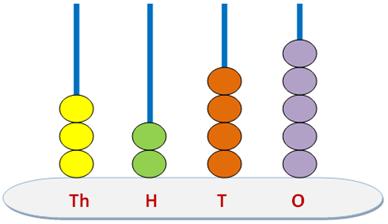
3 2 4 5
In ones or unit place there are five beads that represents 5; in tens place there are four beads that represents 4; in hundreds place there are two beads that represents 2 and in thousands place there are three beads that represents 3.
(ii)
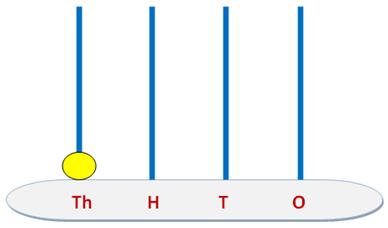
1 0 0 0
In ones or unit place there is no beads that represents 0; in tens place also there is no bead that represents 0; in hundreds place also there is no bead that represents 0 and in thousands place there is only one bead that represents 1.
(iii) Represent 4,057 on Abacus.
- Thousands: 4 beads
- Hundreds: 0 beads
- Tens: 5 beads
- Ones: 7 beads
👉 So, place:
- 4 beads on thousands spike
- 0 beads on hundreds spike
- 5 beads on tens spike
- 7 beads on ones spike
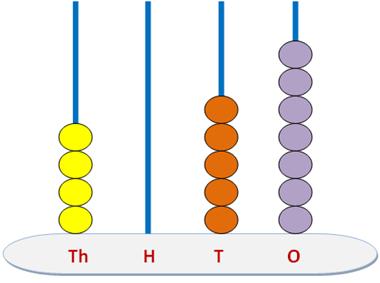
4 0 5 7
In ones or unit place there are seven beads that represents 7; in tens place there are five beads that represents 5; in hundreds place there is no beads that represents 0 and in thousands place there are four beads that represents 4.
👉 Note: Even if a place has 0, we leave that spike empty.
Representing 4-digit numbers on a spike abacus becomes easy when you understand place values. By practicing different examples, you can quickly learn how numbers are formed and represented visually.
Answer:
To represent a 4-digit number on a spike abacus, place beads according to each digit:
- Thousands → thousands spike
- Hundreds → hundreds spike
- Tens → tens spike
- Ones → ones spike
Each digit shows how many beads to place on that spike.
Answer:
Each spike represents a place value:
- Ones (rightmost)
- Tens
- Hundreds
- Thousands (leftmost)
Answer:
If a digit is 0, no beads are placed on that spike. However, the place value is still important and must be considered.
Answer:
Learning the abacus helps students:
- Understand place value clearly
- Improve counting skills
- Develop strong mental math abilities
- Build confidence in mathematics
Related Concept
● Numbers Showing on Spike Abacus.
● 1 Digit Number on Spike Abacus.
● 2 Digits Number on Spike Abacus.
● 3 Digits Number on Spike Abacus.
● 4 Digits Number on Spike Abacus.
● 5 Digits Number on Spike Abacus.
● Problems Related to Place Value.
● Example on Comparison of Numbers.
● Successor and Predecessor of a Whole Number.
● Formation of Numbers with the Given Digits.
● Formation of Greatest and Smallest Numbers.
● Examples on the Formation of Greatest and the Smallest Number.
From 4 Digits Number on Spike Abacus to HOME PAGE
Didn’t find what you were looking for? Or want to know more information
about Math Only Math.
Use this Google Search to find what you need.